
You’ve been there, done that on TikTok. Someone enters a birth date, a geometric chart appears, and they seem genuinely shaken: “This describes me perfectly.” Is the Matrix of Destiny accurate, or is it just another internet fad? Is the Matrix of Destiny geocentric? I think that’s a fair question. And you can get a fair answer–not a sales pitch masquerading as a truthful review.
On this site, we run the free Calculator of the Matrix of Destiny, so we do have a vested interest in this system. We’re being straightforward with you. But we also believe the most helpful thing we can do is to give you a truly honest breakdown of what the Matrix of Destiny really does, what the psychology behind it says, and where it’s really limited.
By the time you finish this article, you’ll have a definitive answer no more of that “it depends” gobbledygook- and a real, down-to-earth perspective you can act on.
Why Are So Many People Asking “Is the Matrix of Destiny Accurate?
There was only one reason why The Matrix of Destiny went viral: it was bizarrely specific. Not vague-horoscope specific. It details personality traits, like behavioural quirks, relationships, and patterns of life that are all too weirdly spot-on for thousands of users.
That kind of resonance naturally leads to skepticism. When you feel that a thing is too true, your mind of reasoning begins to resist. Is this a Barnum effect that psychological effect which makes people see generic statements as personally relevant? Is this confirmation bias? Or is there more meat on these bones?
Those are precisely the right questions. Let’s work them properly.
| The Matrix of Destiny is not a scrying system. Knowing exactly what it does and doesn’t say is the only honest place from which to decide whether it works. |
What Does Matrix of Destiny Actually Claim to Do?
So before you can judge accuracy, you have to know what the system is trying to do in the first place. A majority of conversations are where they fall flat.
The Matrix of Destiny (MoD) is a self-awareness tool, based on numerology, created by Natalia Ladini in 2006. It uses your birth date, does a number of numerological calculations, and associates 22 archetypal energies with certain points on a geometric figure, the octagram (eight-pointed star). Each position on the chart represents a domain of life:
• Center —essence and sense of identity in life, inner self energy, our core personality energy, and primary life purpose
• Top (Sky Line) — your path of spirituality and higher mission
• Bottom (Earth Line) — your material existence, your profession, and the day-to-day world of things
• Left — laid-up past karma and repeated patterns that marched on
• Right — Direction future et potentiel sous, future direction and untapped potential.
• Corners —energies of love, money, health, and family
Critically: Fate Matrix does not tell what is going to happen to you. It doesn’t say “you’ll get a raise in March” or “your relationship is going to end.” It describes the energetic tendencies and archetypal patterns. Whether you are expressing your symptoms of anxiety constructively or destructively, you carry them around with you. This difference is not an escape from responsibility. It’s everything to know if the system functions well. A mirror is not inaccurate because it doesn’t foreshadow. It’s judged for whether it mirrors what’s actually there.
| All energies within the Matrix of Destiny express themselves in two forms: a positive expression (when the energy is active and balanced) and a negative expression (when it is hindered or immature). To grow as a person is to be able to see the state you are in. |
The Psychology Behind It — Why It Resonates
The 22 energies in the Matrix of Destiny are not just random numbers. They correspond to 22 cards from the Major Arcana of Tarot – and these in themselves form a system of structured Jungian archetypes
Carl Jung, the prominent psychologist of the 20th century, believed that there are certain universal motifs — the Hero, the Sage, the Caregiver, the Rebel — that recur across all nations and all time periods as they represent core elements of the human soul. These are not made-up categories. They are observed patterns in human motivation, behaviour, and mind.
When people tell us their Matrix of Destiny chart feels right, they are often having a particular experience: archetypal recognition. The chart puts precise language to patterns that many have felt, but never found words for. That recognition is not false – that is the real power of an archetypal model.
How This Compares to Other Personality Systems
The Matrix of Destiny exists in the same mind science space as a handful of other popular models:
| System | Scientific Status | Mechanism | Practical Usefulness |
| Matrix of Destiny | Not peer-reviewed | Birth date → archetypal mapping | High — specific, multi-dimensional |
| MBTI (Myers-Briggs) | Limited validation | Self-report questionnaire | High — widely used in coaching |
| Enneagram | Limited validation | Self-report questionnaire | High — used in therapy |
| Western Astrology | Not peer-reviewed | Birth date/time/location | Variable — widely used |
| Human Design | Not peer-reviewed | Birth data system | Growing — popular in wellness |
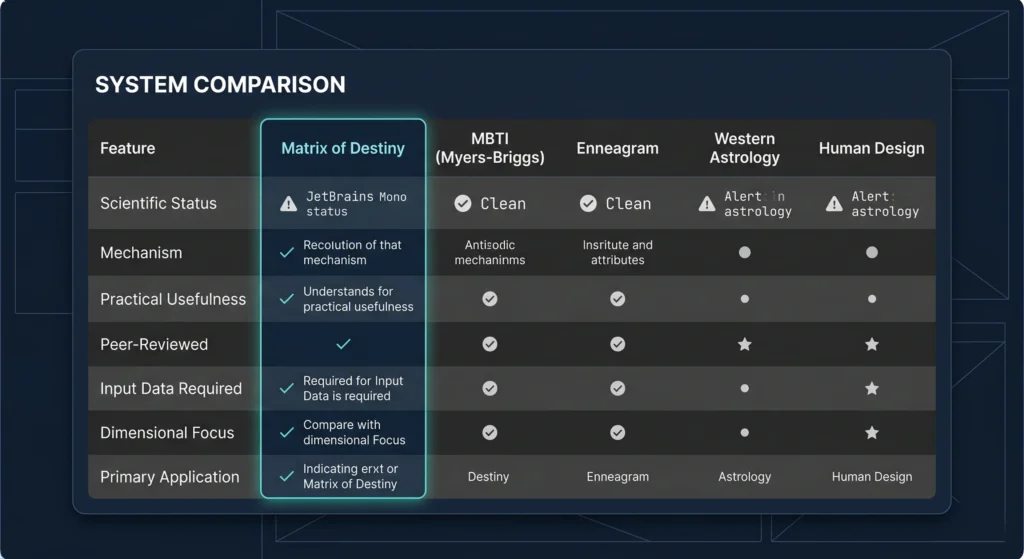
None of these systems have ever been through the double-blind clinical trial gauntlet. Still, each of them is in widespread use, employed by therapists and coaches and applied by millions of people to think about themselves. The question isn’t whether the Matrix of Destiny is peer-reviewed — it isn’t, and neither are most of its peers. The question is: can it help you understand yourself?
Structured frameworks for self-understanding are reliably associated with enhanced self-awareness and decision-making, per the American Psychological Association. The Matrix of Destiny is precisely this kind of matrix.
What Do Real Users Report?
User experience matters. What follows is an honest portrayal of the real comments we receive from people after using the Matrix of Destiny – including their criticisms.
What Users Say Works
• Pattern recognition: I’ve been at this my whole life, and I never had a word for it. — Users often say they recognize authentic patterns of behavior in their energies as shown in their charts.
• Karmic tail accuracy: THE KARMIC TAIL. The description of recurring struggles can be particularly resonant. It’s frequently described by users as “uncomfortable but true.”
• Relationship patterns: The energy position occupies the ego level of consciousness or is a position in ego; nonetheless, they often describe attachment styles and relational patterns with incredible precision.
• Financial energy: People say that financial energy positions more accurately reflect their relationship with money — including unconscious blocks — than they anticipate.
What Users Say Does Not Always Work
• Not every position resonates: the majority of people find 70 to 80 percent of their chart accurate, though of course some positions feel less applicable. It’s just part of any personality system.
• No two readers agree 100%: Individual analysts can have different interpretations of the same chart, which undermines confidence in particular observations.
• Age and life stage matter: Certain ranks in the chart turn more on as you grow older. What doesn’t resonate at 22, often deeply resonates at 35.
| Most users will say that 70–80% of their chart feels really spot on. The rest, 20–30% , they usually understand more later on — particularly karmic positions that explain patterns that are not yet fully unfolded. |
Addressing the Strongest Criticisms Honestly
1. “This Is Just the Barnum Effect.”
The Barnum effect is a cognitive bias in which ordinary people believe very generic and broad statements about their personality made by psychics to be very accurate, and is generally used in horoscopes like “you feel insecure sometimes” or “you are someone who values honesty”. It’s a real psychological phenomenon, and it is a valid concern.
But the Matrix of Destiny does not produce vague statements. Your chart has real archetypes, in real locations — and those mix-and-matches vary quite a bit person to person. If you compare your chart to a friend born on a different day, the contrasts leap out at you. When a system actually generates different outputs for different people, that system is not displaying the Barnum effect – it is revealing person-specific information.
2. “Birth Dates Cannot Determine Personality.”
This is the most profound philosophical question, and an honest engagement with it means directly facing the fact that simply because your date of birth is available information about you does not imply that there is a known causal mechanism that links your date of birth to your personality.
That is Matrix of Destiny’s position; it says there is not one. It processes the birth date through a mathematical formula that aligns with archetypal energies. That this mapping is really a reflection of something in the fabric of the universe, or that it is just a structured mirror for your face — that’s a decision you get to make.
Both readings are legitimate applications of the method. You do not have to believe that birth dates have cosmic significance in order to take advantage of the matrix provided archetypal framework.
3. “There Is No Scientific Evidence.”
True. And that matters — you should know it from the outset. The Matrix of Destiny has not been peer-reviewed or clinically tested, and any site that states otherwise is not being truthful with you.
What we can tell you is that the archetypal template it employs –Jungian psychology – is very well supported in academia. Jung’s archetypes have been deeply researched and continue to be the basis of contemporary psychology, therapy, and coaching. The matrix takes this framework and applies it through the lens of numerology – that lens isn’t science-based, but the framework itself has real psychological grounding.
| Bottom line on scientific evidence: the Matrix of Destiny is not proven. MBTI, the Enneagram, and Human Design are not either. The question for us is not scientific verification but practical value, and a very large yes to that. |
Matrix of Destiny Accuracy vs Other Self-Discovery Systems
If you’re wondering which system is worth the effort, here is a truthful side-by-side comparison:
| Feature | Matrix of Destiny | Western Astrology | Bazi (Chinese) | MBTI |
| Input required | Date of birth only | Date + time + location | Date + time | Self-report quiz |
| Number of life dimensions | 20+ positions | 12 houses + planets | 4 pillars + elements | 4 dichotomies |
| Specificity | Very high | High | Very high | Moderate |
| Karmic/pattern focus | ✅ Strong | ✅ Moderate | ✅ Strong | ❌ Not a focus |
| Scientific validation | ❌ None | ❌ None | ❌ None | ⚠️ Partial |
| Learning curve | Moderate | High | Very high | Low |
| Free to use | ✅ Yes | ⚠️ Partial | ⚠️ Partial | ⚠️ Partial |
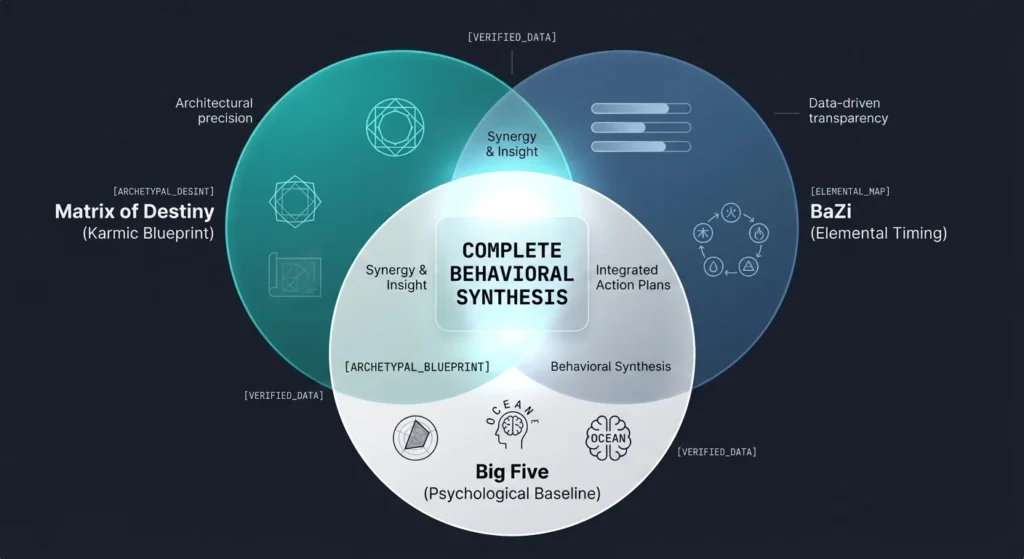
The most powerful method to get the deepest image of oneself is in fact to use multiple systems rather than one. This is precisely what MatrixArchetype.com provides: the Matrix of Destiny together with the free Bazi calculator and the Jungian Archetype Quiz, giving you a complete self-discovery profile no single system can offer.
How to Test Matrix of Destiny Accuracy for Yourself
The most honest answer to “is it accurate?” is: try it with genuine openness and evaluate for yourself. Here is a practical approach that avoids both blind belief and reflexive dismissal:
1. Calculate your chart. Use the free Matrix of Destiny calculator — Type in your birthday and see your chart in a matter of seconds. No sign-up needed.
2. Start with your center number. This is the most important alignment — it is the source of your life energy and life path. Read all of the positive and negative state narratives thoroughly.
3. Read the karmic tail. This outlines persistent problems and trends. Most readers feel this is the best section, and also the most unsettling.
4. Evaluate honestly. Ask yourself: does this represent recurring themes in my life? Not whether every word fits, but whether the entire image represents something real about how you work.
5. Compare with Bazi and Archetype. After you have read your Matrix reading, take a look at the Bazi calculator and the Archetype Quiz to see how the three systems compare and amplify one another.
| Most people who genuinely mean to approach the Matrix of Destiny with an open mind – not expecting to see magic, and not trying to prove that it’s magic – say that it seems to reveal actual patterns that are worth thinking about. That is its true value proposition. |
Frequently Asked Questions
Is Matrix of Destiny scientifically proven?
Answering your question, Matrix of Destiny has not been scientifically proven with peer-reviewed clinical research. It is a self-reflection tool based on archetypal psychology — the same school of thought as Jungian analysis — but the numerological system used to generate it is not scientifically validated. Treat it as a high-powered self-awareness tool, not a clinical diagnosis.
How accurate is Matrix of Destiny compared to astrology?
Both systems work without any scientific proof, and both are based on archetypal structures. It only needs your birth date (no time or place); it allows you to get more specific, position-based readings in over 20 areas of life, and it places a greater emphasis on karmic patterns and personality tendencies. Western astrology is very good for timing and cyclical prediction. Neither is URAMEKEFI — they provide different lenses.
Can Matrix of Destiny predict my future?
No. The Matrix of Destiny does not predict. It is a reading of the energetic trends and archetype patterns you carry and are expressing (constructive or destructive). The future is not predetermined in this system; knowing your patterns empowers you to create different results.
Why does Matrix of Destiny feel so accurate to so many people?
Two motives are at work. First, the system is based on Jungian archetypes — universal patterns of human experience which have real behavioral manifestations. Secondly, the multi-position chart yields specific, differentiated readings as opposed to generalized statements, thus decreasing the Barnum effect. Whenever a specific description fits a real pattern, the recognition is real — not illusory.
Is Matrix of Destiny the same as tarot?
No. The Matrix of Destiny employs the 22 Major Arcana as a symbolic system — the meaning of each archetype shapes how a particular energy is expressed. But it is not a tarot reading. Dibs on those cards, people! No cards are drawn, no reader is necessary, and the calculation is based solely on your date of birth. The relationship is symbolic, not procedural.
What is the difference between Matrix of Destiny and numerology?
Conventional numerology usually boils down your birthdate to one Life Path Number. The Matrix of Destiny derives 20+ unique energy positions within a geometric design, incorporates the 22 Major Arcana symbolism, and aligns energies to particular areas of life. It is far more comprehensive and multi-dimensional than normal numerology.
Does Matrix of Destiny work for everyone?
Not equally. Most people feel that 70-80 per cent of their chart is resonant. Some placements feel right on point while others feel a little off. This is true in any personality system – no one system describes every facet of a person with the same level of precision. The value is in the patterns that do resonate and the introspection they promote.
Is Matrix of Destiny better than Bazi or Archetype Quiz?
Every system is viewing from a different perspective. The Matrix of Destiny shows you your energetic blueprint as well as your karmic patterns. Bazi (Chinese Astrology) shows your elemental nature and life timing cycles. The Jungian Archetype Quiz allows you to discover your core behavioral patterns based on your own answers. As a combination, they give a significantly more comprehensive view than any system by itself.
Final Verdict: Is Matrix of Destiny Worth Your Time?
So here is the real answer:
What it is not: a scientifically validated method or system, a predictive instrument, or a replacement for therapy or other professional advice.
It is a structured, layered self-reflection framework based on Jungian archetypal psychology. It delivers highly unique, distinct readings that a huge majority of users find truly moving — especially involving personality patterns, karmic trends, and life challenges.
If you use it as a mirror and not a prophecy — as a way to observe patterns and get better questions about your life — Matrix of Destiny can be quite valuable. Not metaphysical chauvinism, but real self-realization. And for many people, that’s worth far more than a system for telling fortunes that says it knows your future.
The best way to answer this question for yourself is to take the free Matrix of Destiny calculator now, read your chart with true openness, and judge for yourself.
| Calculate for free with our Matrix of Destiny Calculator no sign-up, no credit card. View your personal chart in seconds and judge the accuracy for yourself. |
Further Reading
For an academic overview of Jungian archetypes and their role in modern psychology, the foundation the Matrix of Destiny draws on, see: Carl Jung and Archetypes — Simply Psychology →

Researcher and writer at matrixarchetype.com covering the intersection of classical metaphysical systems and modern behavioral psychology. Specializes in BaZi, Destiny Matrix, and Big Five synthesis methodology.